

14 Jan 2025
Set Operations - Union, Intersection & Difference
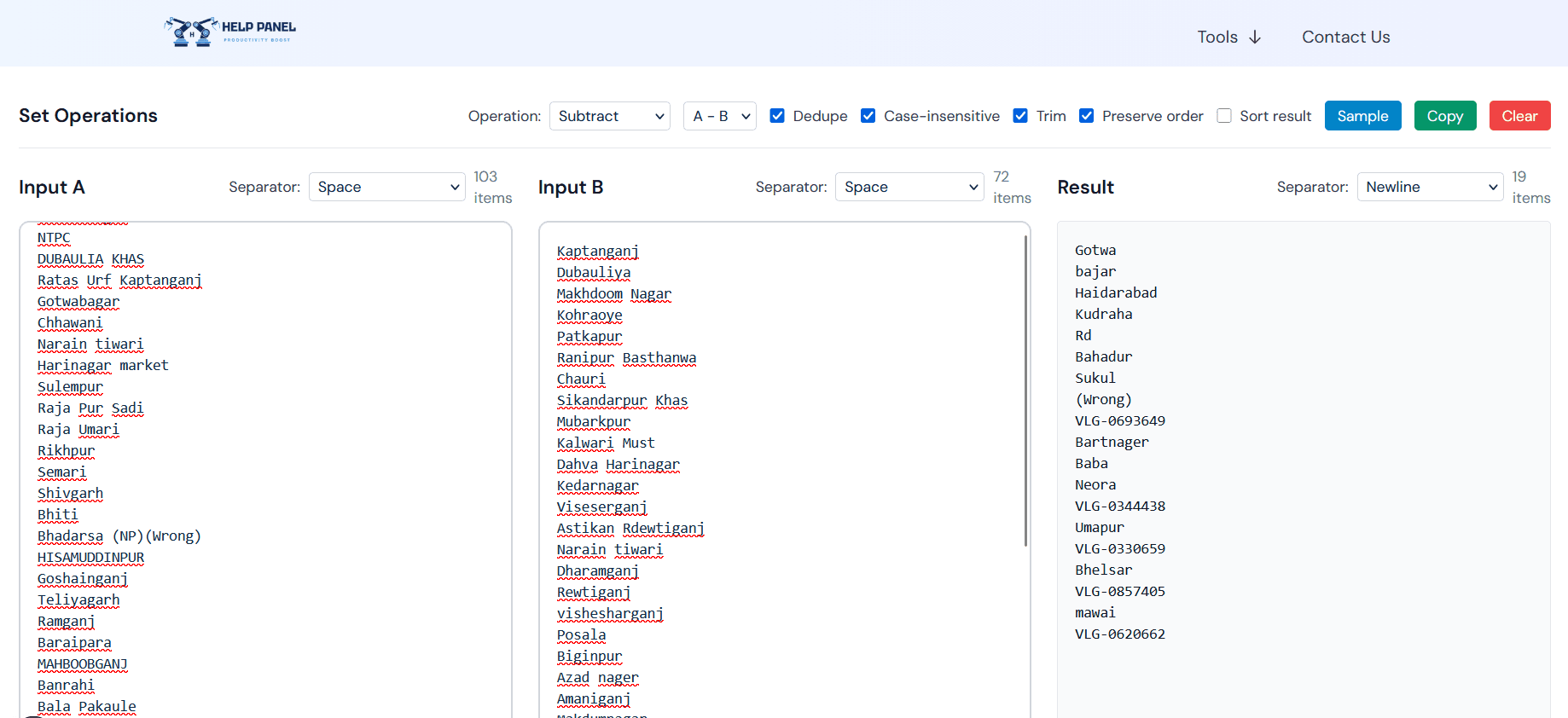
Set Operations Guide
Set operations are mathematical functions used to compare and combine lists. Perfect for data analysis and comparison.
Understanding Set Operations
Union
Combine two lists and remove duplicates. Shows all unique items from both lists.
Intersection
Find items that appear in BOTH lists. Shows common elements only.
Difference/Subtraction
Find items in the first list that DON'T appear in the second list.
Real-World Applications
User Management
- Union: Combine user lists from multiple sources
- Intersection: Find users in both systems
- Difference: Find users only in one system
Product Comparison
- Union: All products from multiple catalogs
- Intersection: Products in stock across all warehouses
- Difference: Products unique to one supplier
Data Analysis
- Union: Merge datasets
- Intersection: Find correlations
- Difference: Identify missing data
Access Control
- Union: Combined permissions
- Intersection: Shared access levels
- Difference: Unique permissions
How to Use
- Enter your first list
- Enter your second list
- Select the operation (Union, Intersection, or Difference)
- Choose your separator
- Get instant results
Mathematical Examples
Union Example
List A: [1, 2, 3] List B: [3, 4, 5] Result: [1, 2, 3, 4, 5]
Intersection Example
List A: [1, 2, 3] List B: [2, 3, 4] Result: [2, 3]
Difference Example
List A: [1, 2, 3] List B: [2, 3, 4] Result: [1]
Best Practices
- Ensure consistent formatting in both lists
- Use the same separator for both inputs
- Verify results before using in analysis
- Consider case sensitivity for text comparisons
Use Cases
Email Marketing
Find common subscribers, remove duplicates.
Inventory Management
Compare stock across locations.
Research Data
Analyze overlapping datasets.
System Administration
Compare user access and permissions.
Master set operations for powerful data analysis!